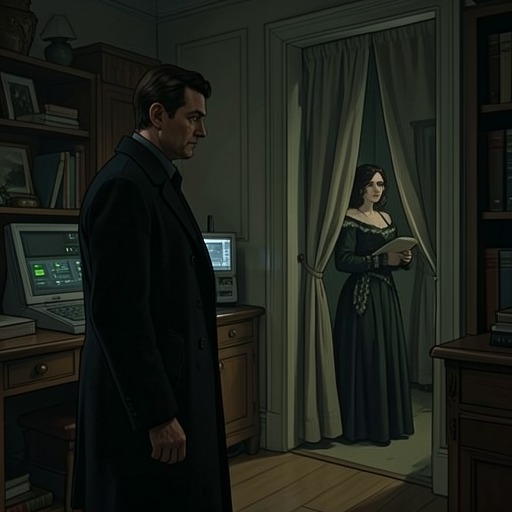
The pursuit of phantoms
In Search of Lost TimeThe pursuit of phantoms is the narrator’s name for a recurring structure of desire: he gives up conventional rewards to pursue people whose reality is partly his own imagining, only to see the object fade and find himself pursuing another. On the roads around Balbec, his journey back to Albertine becomes at once a reunion, a repetition of earlier attachments, and a recognition that the pattern may govern his life.
The Roads as a Map of Desire
When Albertine chooses to stay at Saint-Jean-de-la-Haise to paint, the narrator drives away under the pretense of having other things to do. He may travel as far as Saint-Mars-le-Vieux or Criquetot, but often goes no farther than the plain above Gourville. Its resemblance to the plain above Combray, toward Méséglise, lets distance itself become a form of connection: he imagines the sea breeze reaching through Quetteholme to the trees around Saint-Jean-de-la-Haise and caressing Albertine’s face. Though apart, they seem joined across the landscape. The return roads have changed meaning without changing their shape. Once, before the sea came into view between the branches, the narrator closed his eyes to imagine its ancient agitation; now he reads the roads as the route back to Albertine. Their familiar straight stretches and turns bring back earlier journeys made in pursuit of Mlle de Stermaria and in the hope of encountering the Duchesse de Guermantes. The landscape becomes less a succession of destinations than a record of the desires that have carried him along it.
A Recurrent Pursuit
The narrator recognizes that he has repeatedly pursued people whose importance cannot be measured by fortune, success, or social position. For someone with his disposition, those fixed worldly values do not count: what matters is the phantom, the imagined figure that commands his efforts and makes other aims subordinate. But the phantom soon fades. He runs after another, then may return to the first. Albertine is not simply a new object of desire. The narrator has sought her before, as the girl first glimpsed against the sea, but other women have intervened between that earlier Albertine and the woman he now rarely leaves. The narrative sets his former efforts over Gilberte and the Duchesse de Guermantes beside his present preoccupation with Albertine: becoming the Duchesse’s friend has not secured lasting desire for her; his attention has moved on. The same roads hold these pursuits together, while their changing objects expose how little possession or social proximity can settle longing.
Return, Repetition, and Work
The narrator compares his experience with Swann’s, who might have understood the pursuit of phantoms: a sought-after meeting can briefly seem to establish contact with an unreal life, only for that life to fade at once. Balbec’s roads are crowded with such forgotten and renewed pursuits. The comparison makes the pattern larger than one attachment, while preserving its particular recurrence in the narrator’s movements between Albertine and earlier figures. As the narrator thinks of the pear trees, apple trees, and tamarisks outliving him, their enduring presence seems to offer a silent counsel: he should at last set himself to work before eternal rest arrives. The thought gives the landscape a measure of time that desire itself lacks. Human attachments shift and return; the trees remain, and their continuity presses the narrator toward work while he is still alive.